I was so affected by the right-wing reaction to the re-election of the President of the United States that I was moved to blog again for the first time in almost a year. The loss of the Republican candidate was, in the truest sense of the word, tragic: both for him and for his supporters (including Fox News).
It was tragic because they had truly deluded themselves that they were going to win. Every election, both sides bluster about their impending victory in order to project confidence and keep their voters optimistic (if not complacent). So, conservative pundits convinced their listeners - and, it would appear, themselves - that the "scientific gobbledegook" of the aggregated poll information, compiled by analysts like Nate Silver at FiveThirtyEight and Real Clear Politics, was corrupted by liberal bias and distracting from an inevitable Romney landslide victory. Here's a taste of one of the worst offenders, Dick Morris:
Like so many tragic characters before them, throughout literature and world history, their delusions would not outlast reality - let alone change it. When the state of Ohio, and by extension the election, was called as an Obama win (indeed, a landslide), the Romney supporters, so confident of their own victory, underwent their peripeteia.
Peripeteia is the Greek word, associated most often with Oedipus Tyrannus, that describes the reversal, the complete inversion, of a character's world. Every misapprehension under which s/he laboured is shown to be false, every action taken on the basis of that misprision shown to be misguided.
It is the climax of dramatic irony - where the audience knows the truth of the situation (Oedipus is Laius' killer and is married to his mother/Obama will overwhelmingly win the electoral college) but the character refuses to accept it, even in the face of suggestion and evidence. This culminates in the inescapable revelation to the character of what the audience knew all along.
So when Romney is said to be "shell-shocked" by his loss, or Fox News and Romney campaign contributor (zeugma?) Karl Rove holds out in his delusion until reality, the ineluctable fate of his own demise, engulfs him, we should see the silhouette of Oedipus, of Aegisthus, of Creon, caught in the headlights of their peripeteia. Megyn Kelly even performs her own pilgrimage to Delphi:
But the tragic irony doesn't end there. We had already seen, through the primaries and for most of the Presidential race, Romney forced to abandon his moderate nature in order to keep his radicalised party on side, especially on women's issues: that moderation was what would have allowed him to beat a very vulnerable President; that very extremism would prove to be his downfall.
It is moreover (deliciously?) ironic that the anti-scientific stance adopted by the extreme Republican campaign, which led right-wing pundits and aides to pooh-pooh the polls, was the very source of the self-imposed ignorance of reality which would ultimately make the peripeteia so devastating, as well as being a large part of the reason that they lost (which, as pointed out above, was otherwise perfectly avoidable). Could Sophocles have done better?
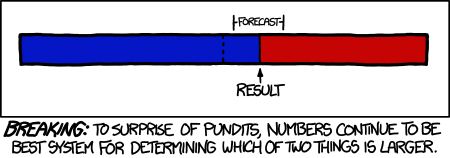
Those in America should check out The Daily Show's masterful dissection of this (in which Jon Stewart correctly describes the Republican reaction as "tragic") here. More succinctly and accessibly, xkcd:

It was tragic because they had truly deluded themselves that they were going to win. Every election, both sides bluster about their impending victory in order to project confidence and keep their voters optimistic (if not complacent). So, conservative pundits convinced their listeners - and, it would appear, themselves - that the "scientific gobbledegook" of the aggregated poll information, compiled by analysts like Nate Silver at FiveThirtyEight and Real Clear Politics, was corrupted by liberal bias and distracting from an inevitable Romney landslide victory. Here's a taste of one of the worst offenders, Dick Morris:
Like so many tragic characters before them, throughout literature and world history, their delusions would not outlast reality - let alone change it. When the state of Ohio, and by extension the election, was called as an Obama win (indeed, a landslide), the Romney supporters, so confident of their own victory, underwent their peripeteia.
Peripeteia is the Greek word, associated most often with Oedipus Tyrannus, that describes the reversal, the complete inversion, of a character's world. Every misapprehension under which s/he laboured is shown to be false, every action taken on the basis of that misprision shown to be misguided.
It is the climax of dramatic irony - where the audience knows the truth of the situation (Oedipus is Laius' killer and is married to his mother/Obama will overwhelmingly win the electoral college) but the character refuses to accept it, even in the face of suggestion and evidence. This culminates in the inescapable revelation to the character of what the audience knew all along.
So when Romney is said to be "shell-shocked" by his loss, or Fox News and Romney campaign contributor (zeugma?) Karl Rove holds out in his delusion until reality, the ineluctable fate of his own demise, engulfs him, we should see the silhouette of Oedipus, of Aegisthus, of Creon, caught in the headlights of their peripeteia. Megyn Kelly even performs her own pilgrimage to Delphi:
But the tragic irony doesn't end there. We had already seen, through the primaries and for most of the Presidential race, Romney forced to abandon his moderate nature in order to keep his radicalised party on side, especially on women's issues: that moderation was what would have allowed him to beat a very vulnerable President; that very extremism would prove to be his downfall.
It is moreover (deliciously?) ironic that the anti-scientific stance adopted by the extreme Republican campaign, which led right-wing pundits and aides to pooh-pooh the polls, was the very source of the self-imposed ignorance of reality which would ultimately make the peripeteia so devastating, as well as being a large part of the reason that they lost (which, as pointed out above, was otherwise perfectly avoidable). Could Sophocles have done better?
Those in America should check out The Daily Show's masterful dissection of this (in which Jon Stewart correctly describes the Republican reaction as "tragic") here. More succinctly and accessibly, xkcd: